GitHub Introduction



GitHub in GEN242
- Note, this class will make heavy use of GitHub
- Homework assignments will be submitted and graded on GitHub Classroom
- Course projects will also use private GitHub repositories: one repository for each course project (shared among students of each project)
- Each student will need a personal GitHub account. They can be created here.
- GitHub provides an unlimited number of free public repositories to each user. Via GitHub Education students can sign up for an extended number of free private GitHub accounts (see here).
- For beginners this quick guide may be useful
What are Git and GitHub?
- Git is a version control system similar to SVN
- GitHub is an online social coding service based on Git
- Combined Git/GitHub: environment for version control and social coding
Installing Git
- Install on Windows, OS X and Linux
- When using it from RStudio, it needs to find the Git executable
Git Basics from Command-Line
Also try interactive git tutorial.
Finding help from command-line
Initialize a directory as a Git repository (here
my_repos).Add specific files to Git repository (staging area)
Add all files recursively
To ignore specific files (e.g. temp files), list them in a
.gitignorefile in your repository’s root directory. Regular expressions are supported. See here for more details.After editing file(s) in your repos, record a snapshot of the staging area
GitHub Basics from Command-Line
Generate a new remote repository on GitHub online with same name as in previous section (or use hub or GitHub CLI command-line wrappers for this). To avoid errors with the online method, do not initialize the new repository with README, license, or
.gitignorefiles. You can add these files after your project has been pushed to GitHub.Push updates to remote. Next time one can just use
git pushClone existing remote repository
Before working on project, update local git repos
Make changes and recommit local to remote
Important When Working with Private GitHub Repositories!
In order to work with private GitHub repositories, like the ones used in GEN242, users need to activate in their GitHub account under Settings as authentication method an SSH Key. The latter SSH Key method is usually preferred. To push to a private GitHub repository from the HPCC cluster, you need to generate an SSH Key from your home account on the HPCC cluster using the standard Linux ssh-keygen method as described here, and then upload the newly generated public SSH Key of your HPCC account located under ~/.ssh/id_rsa.pub to GitHub. The same method can be used to create an SSH Key on a personal computer and then upload the public key to GitHub. Usually, one should create a dedicated key pair for each computer one uses and upload the corresponding public keys to GitHub. If you are new to SSH Keys, then please read this short introduction.
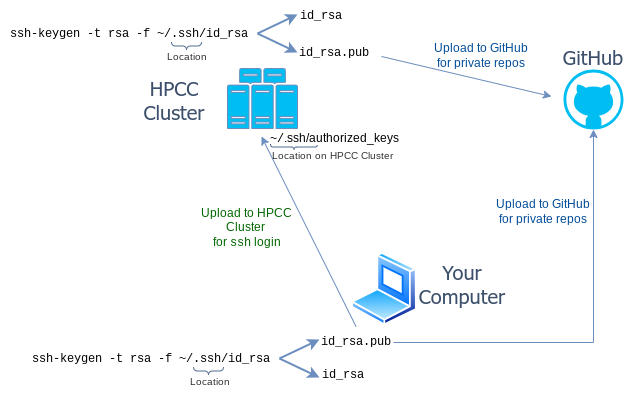
Fig 1: SSH Keys required to work with private GitHub repos from a local computer as well as a remote system like the HPCC Cluster. The figure also includes the SSH Key required for password-less login to the remote system (here HPCC cluster). For generating SSH keys, see here.
SSH Key Setup for GitHub Access
To push and pull from your private GEN242 GitHub repositories, you need to authenticate with GitHub using an SSH key. The process involves generating an SSH key pair on the computer you want to work from, and then uploading the public key to your GitHub account. Since most students work both on the HPCC cluster and on their local computer, this setup needs to be completed separately for each machine — each gets its own key pair, and both public keys get uploaded to GitHub.
Select the tab above that matches your working environment:
- HPCC → GitHub — working on the HPCC cluster
- macOS/Linux → GitHub — working on a local Mac or Linux computer
- Windows (MobaXterm) → GitHub — working on a local Windows computer
If you work from both HPCC and a local computer, complete the HPCC tab first, then return and complete your local computer tab.
Step 1: Generate an SSH key pair on HPCC
Log into HPCC via MobaXterm (Windows) or Terminal (macOS/Linux) and run the following commands on the HPCC cluster:
Follow the prompts. You may set a passphrase or leave it blank. Once complete you will find two files in your ~/.ssh/ directory:
id_rsa— your private key (never share this)id_rsa.pub— your public key (this gets uploaded to GitHub)
Step 2: Copy your public key
Select and copy the entire output line.
Step 3: Upload the public key to GitHub
- Go to github.com and click your profile picture → Settings
- In the left sidebar click SSH and GPG keys → New SSH key
- Give it the title
HPCC - Paste the public key and click Add SSH key
Step 4: Test the GitHub SSH connection from HPCC
A successful setup returns: Hi <username>! You've successfully authenticated...
Step 5: Clone your private GEN242 repo using the SSH URL
On your repo page on GitHub click Code → SSH and copy the URL, then run:
Replace <username> with your GitHub username. All subsequent git push and git pull commands inside that directory will use SSH automatically.
Step 1: Generate an SSH key pair on your local computer
Open Terminal and run the following commands on your local machine:
Follow the prompts. You may set a passphrase or leave it blank. Once complete you will find two files in your ~/.ssh/ directory:
id_rsa— your private key (never share this)id_rsa.pub— your public key (this gets uploaded to GitHub)
Step 2: Copy your public key
Select and copy the entire output line.
Step 3: Upload the public key to GitHub
- Go to github.com and click your profile picture → Settings
- In the left sidebar click SSH and GPG keys → New SSH key
- Give it the title
macOS laptoporLinux desktopas appropriate - Paste the public key and click Add SSH key
Step 4: Test the GitHub SSH connection
A successful setup returns: Hi <username>! You've successfully authenticated...
Step 5: Clone your private GEN242 repo using the SSH URL
On your repo page on GitHub click Code → SSH and copy the URL, then run:
Replace <username> with your GitHub username. All subsequent git push and git pull commands inside that directory will use SSH automatically.
Download and install MobaXterm
Download the Installer edition (green button) from mobaxterm.mobatek.net. If your IT department does not allow software installation, use the Portable edition instead — but note that you will need to configure a persistent home directory under Settings → General → Persistent home directory to avoid losing your SSH keys between sessions.
Step 1: Open MobaXterm’s local terminal
In MobaXterm click Start local terminal. This opens a bash shell running locally on your Windows machine. All commands below are run here — not in an HPCC session.
Step 2: Generate an SSH key pair
Follow the prompts. You may set a passphrase or leave it blank. The key pair is saved in MobaXterm’s local home directory, which on Windows is located at:
C:\Users\<WindowsUsername>\Documents\MobaXterm\home\.ssh\The two files created are:
id_rsa— your private key (never share this)id_rsa.pub— your public key (this gets uploaded to GitHub)
Step 3: Copy your public key
To avoid accidentally copying extra whitespace (which will break the key), you can alternatively use MobaXterm’s built-in file browser: open the left sidebar → navigate to ~/.ssh/ → right-click id_rsa.pub → open with text editor → select all and copy.
Step 4: Upload the public key to GitHub
- Go to github.com and click your profile picture → Settings
- In the left sidebar click SSH and GPG keys → New SSH key
- Give it the title
Windows laptop - Paste the public key and click Add SSH key
Step 5: Configure Git identity (first time only)
MobaXterm’s local terminal may not have your Git identity set. Run:
Step 6: Test the GitHub SSH connection
A successful setup returns: Hi <username>! You've successfully authenticated...
Step 7: Clone your private GEN242 repo using the SSH URL
On your repo page on GitHub click Code → SSH and copy the URL, then run:
Replace <username> with your GitHub username. All subsequent git push and git pull commands inside that directory will use SSH automatically.
Simple Working Routine for Homeworks and Projects
To upload and sync homeworks and projects to GitHub, run the following git/GitHub workflow from the command-line after your SSH key is set up (see above) and after your private homework or project repository has been shared with you via a GitHub invitation email. The workflow is identical whether you are on HPCC, a Mac/Linux computer, or MobaXterm’s local terminal on Windows.
# Clone your repo (first time only, on each machine you use)
git clone git@github.com:GEN242-2026/<username>-hw.git
cd <username>-hw

# Always pull first to get the latest changes before starting work
git pull

# Create or edit files, then stage and commit your changes
touch test                    # creates an empty file for testing
git add test                  # stage a specific file, or use 'git add -A' for all changes
git commit -am "some edits"   # commit with a short descriptive message
git push                      # upload commits to GitHub

# -> Edit the test file directly on GitHub online, then run git pull to sync changes back
git pull
Online file upload
Useful for new users who want to upload their homework assignments to GitHub but are not familiar enough with the command-line yet.
- Press
Add filebutton on your repository, and thenUpload files. - Under the file path window add required subdirectory structure and a dummy file name (e.g.
Homework/HW1/dummy.txt) - After this press
Upload filesand upload any file (e.g. homework) to the newly create directory. After this the initial dummy file can be deleted. The latter is necessary since empty directories are not visible on GitHub.
Using GitHub from RStudio
Note: one can also set up SSH Keys from RStudio. How to do this is explained here.
After installing Git (see here), set path to Git executable in Rstudio:
- Tools
>Global Options>Git/SVN
- Tools
If needed, log in to GitHub account and create repository. Use option
Initialize this repository with a README.Clone repository by copying & pasting URL from repository into RStudio’s ‘Clone Git Repository’ window:
- File
>New Project>Version Control>Git>Provide URL
- File
Now do some work (e.g. add an R script), commit and push changes as follows:
- Tools
>Version Control>Commit
- Tools
Check files in staging area and press
Commit ButtonTo commit changes to GitHub, press
Push ButtonShortcuts to automate above routines are here
To resolve password issues, follow instructions here.
Viewing static HTML files on GitHub
Simple viewing of HTML files on GitHub can be enabled by making the following changes to a public repos. Without these adjustments, one needs to download an HTML file from GitHub in order to view the rendered content. An example GitHub repos for showcasing this feature is here.
- Make sure your GitHub repos is public
- Go to
Settings - Select
Pagesin menu on left - Select
Deploy from a branchunderSource - Select a branch in the
GitHub Pagessection - Save the changes and wait until a URL is provided for your site.
- To test, upload an HTML file and append its paths to the URL provided in previous step.